【类加载器反射】
第一章 类加载器
1.1 类的加载时机
类(类的.class文件)的加载时机
    1. 创建类的实例。
    2. 类的静态变量,或者为静态变量赋值。
    3. 类的静态方法。
    4. 使用反射方式来强制创建某个类或接口对应的java.lang.Class对象。
    5. 初始化某个类的子类。
    6. 直接使用java.exe命令来运行某个主类。
1.2 类的加载器
1
2
3
4
5
6
7
8
9
10
11
12
13
14
15
16
17
18
19
20
21
22
23
24
25
26
27
28
29
30
31
32
33
34
35
36
37
38
39
40
41
42
43
44
45
46
47
48
49
50
51
52
53
54
55
56
57
58
59
60
61
62
63
64
65
66
67
68
69
70
71
72
73
74
75
76
77
78
79
|
public class MyTest04 {
public static void main(String[] args) {
ClassLoader app = ClassLoader.getSystemClassLoader();
ClassLoader app2 = MyTest04.class.getClassLoader();
System.out.println(app);
System.out.println(app2);
System.out.println(app2 == app);
System.out.println("---------------------");
ClassLoader p1 = ClassLoader.getPlatformClassLoader();
ClassLoader p2 = app.getParent();
System.out.println(p1);
System.out.println(p2);
System.out.println(p2==p1);
System.out.println("---------------------");
ClassLoader c1 = String.class.getClassLoader();
ClassLoader c2 = p1.getParent();
System.out.println(c1);
System.out.println(c2);
}
}
|
1
2
3
4
5
6
7
| public class MyTest05 {
public static void main(String[] args) {
InputStream inputStream = ClassLoader.getSystemClassLoader().getResourceAsStream("1.txt");
System.out.println(inputStream);
}
}
|
第二章 反射
2.1 Class类的介绍
1
2
3
4
5
6
7
| 注意:
1.java文件编译生成.class文件,java文件中的内容就是.class文件中的内容,
只不过.class文件是给JVM看的(称为字节码文件)
2.java是面向对象的编程语言,任何事物都可以定义类,并创建对象,
.class文件也是一种事物,也可以定义类,创建对象
3.jdk中有个类java.lang.Class,是专门用来描述.class文件的
4.该Class类也是有对象的,但是程序员无法自己创建,由jvm帮助创建,程序员可以获取到该Class类型的对象,从而完成相关的操作
|

2.2 反射的介绍
1
2
3
4
5
6
7
8
9
| 注意:
1.当第一次使用类的信息时,该类的.class文件,会被加载到内存中的方法区中
2.jvm同时为加载到内存方法区的.class文件,创建一个Class类型的对象,该对象被保存在堆内存中
相当于堆内存中的Class类型的对象,指向了方法区的.class文件
3.一个类的.class文件,只能被加载一次,所以对应的Class类型的对象,只有一个
4.任意类型(基本类型/引用类型)都有对应的Class类型的对象
什么叫做反射呢?
通过获取Class类型的对象,从而操作对应的.class文件
说白了: 通过Class类型的对象获取.class文件中的成员变量/成员方法/构造方法并执行
|
反射技术,指的是加载类的字节码到内存,并以编程的方法解刨出类中的各个成分(成员变量、方法、构造器等)
反射有啥用呢?
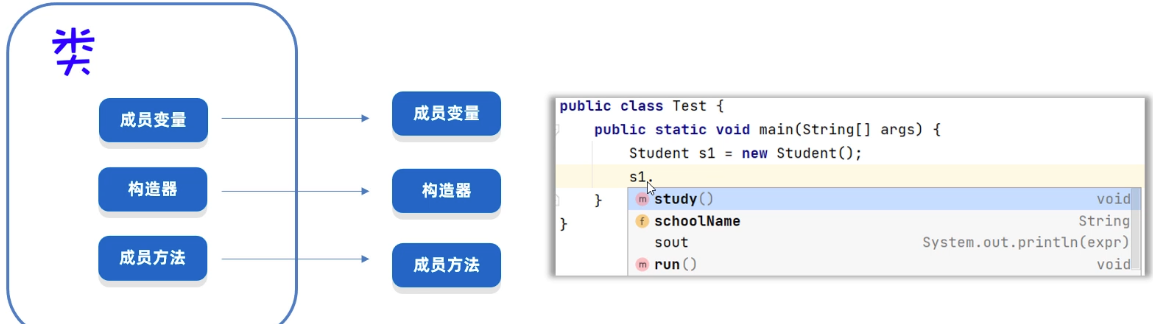
其实反射是用来写框架用的。平时我们用IDEA开发程序时,用对象调用方法,IDEA会有代码提示,idea会将这个对象能调用的方法都给你列举出来,供你选择,如果下图所示
问题是IDEA怎么知道这个对象有这些方法可以调用呢?
原因是对象能调用的方法全都来自于类,IDEA通过反射技术就可以获取到类中有哪些方法,并且把方法的名称以提示框的形式显示出来,所以你能看到这些提示了。
反射具体学什么?
因为反射获取的是类的信息,那么反射的第一步首先获取到类才行。
由于Java的设计原则是万物皆对象,获取到的类其实也是以对象的形式体现的,叫字节码对象,用Class类来表示。
获取到字节码对象之后,再通过字节码对象就可以获取到类的组成成分了,这些组成成分其实也是对象,
其中每一个成员变量用Field类的对象来表示、
每一个成员方法用Method类的对象来表示,
每一个构造器用Constructor类的对象来表示。
如下图所示:
2.4 三种方式获取字节码文件
1
2
3
4
5
6
7
8
9
10
11
12
13
14
15
16
17
18
19
20
|
|
1
2
3
4
5
6
7
8
9
10
11
12
13
14
15
16
17
18
19
20
21
22
23
24
25
26
27
28
29
| public class Test06 {
public static void main(String[] args) throws Exception {
Class a1 = Class.forName("com.zxq._06_获取字节码文件对象.A");
Class b1 = Class.forName("com.zxq._06_获取字节码文件对象.B");
Class a2 = A.class;
Class a3 = new A().getClass();
Class a4 = new A().getClass();
System.out.println(a1 == a2);
System.out.println(a3 == a2);
System.out.println(a3 == a4);
System.out.println(a1 == b1);
System.out.println("----------------");
Class b2 = B.class;
Class b3 = new B().getClass();
Class b4 = new B().getClass();
System.out.println(b1==b2);
System.out.println(b3==b2);
System.out.println(b3==b4);
}
}
public class A {
}
public class B {
}
|
2.5 反射获取构造方法
1
2
3
4
5
6
7
8
9
10
11
12
13
14
15
16
17
18
19
20
21
22
23
24
25
|
|
1
2
3
4
5
6
7
8
9
10
11
12
13
14
15
16
17
18
19
20
21
22
23
24
25
26
27
28
29
30
31
32
33
34
35
| public class C {
private int a;
private double b;
private String c;
private C(String c) {
this.c = c;
}
public C(double b) {
this.b = b;
}
private C(int a) {
this.a = a;
}
public C() {
}
public C(int a, double b, String c) {
this.a = a;
this.b = b;
this.c = c;
}
@Override
public String toString() {
return "C{" +
"a=" + a +
", b=" + b +
", c='" + c + '\'' +
'}';
}
}
|
1
2
3
4
5
6
7
8
9
10
11
12
13
14
15
16
17
18
19
20
21
22
23
24
25
26
27
28
29
30
31
32
33
34
35
36
37
38
39
40
41
42
43
| public class TestC {
public static void main(String[] args) throws Exception {
Class clazz = C.class;
Constructor[] arr1 = clazz.getConstructors();
System.out.println(Arrays.toString(arr1));
Constructor[] arr2 = clazz.getDeclaredConstructors();
System.out.println(Arrays.toString(arr2));
Constructor c1 = clazz.getConstructor();
System.out.println(c1);
Object o = c1.newInstance();
System.out.println(o);
Constructor c2 = clazz.getConstructor(int.class, double.class, String.class);
System.out.println(c2);
Object o1 = c2.newInstance(100, 200.1, "嘿嘿");
System.out.println(o1);
System.out.println("==================================");
Constructor c3 = clazz.getDeclaredConstructor(int.class);
System.out.println(c3);
c3.setAccessible(true);
Object o2 = c3.newInstance(666);
System.out.println(o2);
System.out.println("--------------------------------");
Object o3 = clazz.newInstance();
System.out.println(o3);
}
}
|
2.10 反射获取成员方法
1
2
3
4
5
6
7
8
9
10
11
12
13
14
15
16
17
|
|
1
2
3
4
5
6
7
8
9
10
11
12
13
14
15
| public class D {
private void show1(){
System.out.println("私有的show1...");
}
private void show1(double a){
System.out.println("私有的show1...a="+a);
}
public int show2(int a){
System.out.println("公共的的show2...a="+a);
return 2*a;
}
public void show2(int a,int b){
System.out.println("公共的的show2...a="+a+",b="+b);
}
}
|
1
2
3
4
5
6
7
8
9
10
11
12
13
14
15
16
17
18
19
20
21
22
23
24
25
26
27
28
29
30
31
32
| public class TestD {
public static void main(String[] args) throws Exception {
Class cz = D.class;
Object o = cz.newInstance();
Method[] arr = cz.getMethods();
System.out.println(Arrays.toString(arr));
Method[] arr2 = cz.getDeclaredMethods();
System.out.println(Arrays.toString(arr2));
Method m1 = cz.getMethod("show2", int.class);
Object invoke = m1.invoke(o, 123);
System.out.println("方法返回的结果是:"+invoke);
Method m2 = cz.getMethod("show2", int.class, int.class);
Object invoke1 = m2.invoke(o, 2, 5);
System.out.println(invoke1);
Method m3 = cz.getDeclaredMethod("show1", double.class);
m3.setAccessible(true);
Object invoke2 = m3.invoke(o, 2.2);
System.out.println(invoke2);
}
}
|
2.11反射获取成员属性
1
2
3
4
5
6
7
8
9
10
11
12
13
14
| public class E {
private String name;
private int age;
private double score;
@Override
public String toString() {
return "E{" +
"name='" + name + '\'' +
", age=" + age +
", score=" + score +
'}';
}
}
|
1
2
3
4
5
6
7
8
9
10
11
12
13
14
15
16
17
18
19
20
21
22
23
24
25
26
27
28
29
30
31
32
33
| public class TestE {
public static void main(String[] args) throws Exception {
Class cz = E.class;
Object o = cz.newInstance();
Field[] arr = cz.getDeclaredFields();
System.out.println(Arrays.toString(arr));
Field name = cz.getDeclaredField("name");
name.setAccessible(true);
System.out.println(o);
name.set(o,"张三");
System.out.println(o);
Field age = cz.getDeclaredField("age");
Field score = cz.getDeclaredField("score");
age.setAccessible(true);
score.setAccessible(true);
age.set(o,18);
score.set(o,99.8);
System.out.println(o);
System.out.println(age.get(o));
System.out.println(score.get(o));
}
}
|
2.13 反射案例分析
1
2
3
4
5
6
|
className=com.example.UserService
methodName=sayHello
param=灵星智能商城
|
1
2
3
4
5
6
7
8
9
10
11
12
13
14
15
16
17
18
19
20
21
22
23
24
25
26
27
28
29
30
31
32
33
34
35
36
37
38
39
40
41
42
43
44
45
46
47
48
|
public class MyTools1 {
private MyTools1(){}
public static Object start() throws Exception {
InputStream in = ClassLoader.getSystemClassLoader().getResourceAsStream("my.conf");
Properties p = new Properties();
InputStreamReader isr = new InputStreamReader(in,"utf-8");
p.load(isr);
String className = p.getProperty("className");
Class c = Class.forName(className);
Method method = c.getMethod(p.getProperty("methodName"), String.class);
return method.invoke(c.newInstance(),p.getProperty("param"));
}
}
|
1
2
3
4
5
6
| public class A {
public String abc(String s){
System.out.println("A类的abc方法执行的时候,得到的参数是:"+s);
return s+s;
}
}
|
1
2
3
4
5
6
| public class B {
public Integer bbc(String s){
System.out.println("B类的bbc方法执行的时候,得到的参数是:"+s);
return Integer.parseInt(s)*2;
}
}
|
1
2
3
4
5
6
7
| public class Test01 {
public static void main(String[] args) throws Exception {
Object start = MyTools1.start();
System.out.println("工具返回的结果是:"+start);
}
}
|
1
2
3
4
5
6
7
8
9
10
11
12
13
14
15
16
17
18
19
20
21
22
23
24
25
26
27
|
public class Test02 {
public static void main(String[] args) throws NoSuchMethodException, InvocationTargetException, IllegalAccessException {
List<Integer> list = new ArrayList<>();
list.add(123);
Class c = list.getClass();
Method add = c.getMethod("add", Object.class);
add.invoke(list,"abc");
System.out.println(list);
String name = add.getName();
Class returnType = add.getReturnType();
Class[] parameterTypes = add.getParameterTypes();
Class aClass = add.getDeclaringClass();
String simpleName = aClass.getSimpleName();
String name1 = aClass.getName();
System.out.println("反射的add是:"+simpleName+"类("+name1+")下的:"+name+",参数类型是:"+ Arrays.toString(parameterTypes)+",返回值类型是"+returnType);
}
}
|